 |
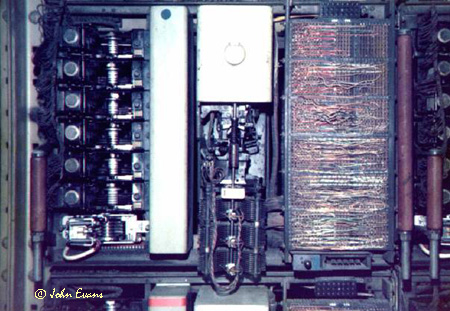
Director Exchanges grew from the requirement for an automatic switch that could route calls between a large number of exchanges that were located within in a small area (e.g. within a city such as London). |
The Original Director Areas
The five original Director Areas developed from 1927 onwards, starting with the opening of Holborn (London) exchange.
|
Numbering
In ND (Non-Director) exchanges (for local calls) the digits dialled by the subscriber are used to directly step the switches. Linked numbering schemes (LNS) minimise the number of separate junctions between exchanges. A large LNS might include as many as 20 exchanges.
In Director exchanges (for local calls) the digits dialled by the subscriber are translated into routing digits which identify the destination exchange. This allowed a very large local call area with a single access code, e.g. London (01) which had more than 250 Director exchanges. This has evolved historically from the large number of manual exchanges and the concentration of lines in a comparatively small geographical area.
To do this, the Director system used the exchange code as part of the telephone number...
For example, Whitehall 1212
Under the manual system:
Whitehall was the exchange name and 1212 was the telephone number.
Under auto exchange working
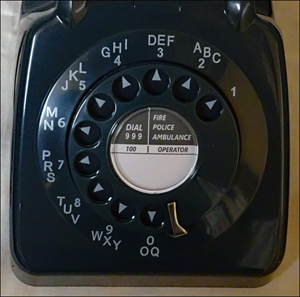 |
Callers dialled WHI to reach Whitehall exchange and 1212 for the telephone number. |
As STD became available from 1958 onwards, before AFN, callers outside of London dialled
01 WHI 1212
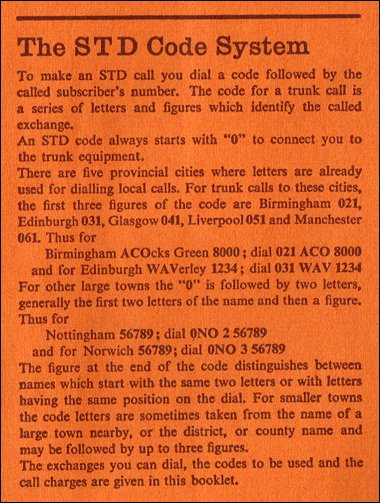 |
Extract from DIB - Dialling Instruction Booklet 1964. |
With the progressive roll out of All-Figure Numbers (AFN) from 1965 onwards, London telephone numbers became 7-digits.
Some of the codes previously used under the mixed letter and number scheme were changed to give greater flexibility of codes. The code for Whitehall was changed from 944 to 930.
Thus WHI 1212 became 930 1212
With AFN this was then shown as 01-930 1212.
Callers within the London Director Area dialled the 7-digit number 930 1212, and callers outside of the LDA dialled 9-digits 01-930 1212.
The 930 code was translated to switch the call to the Whitehall exchange (from any location in London) and the 1212 was the actual number switched to.
See London Codes for more details.
All logos and trade marks are the property of their respective owners and are used on the Light Straw site(s) for review only. Students and researchers are recommended to make their own independent enquiries as to the accuracy of the information contained therein.